
Overview
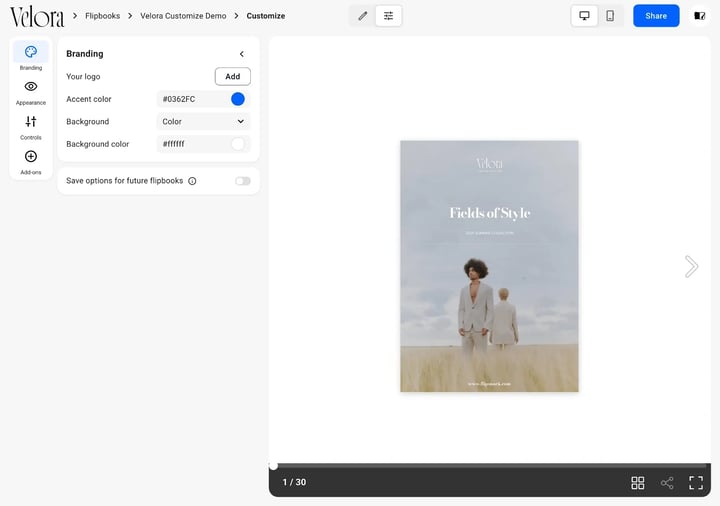
The Customize page sets how one flipbook looks and behaves for the people who read it. Four panels sit in the left rail: Branding, Appearance, Controls and Add-ons. Branding carries your logo and colors, Appearance decides how pages turn, Controls decides what a reader is allowed to do, and Add-ons opens the features that have a screen of their own. To put any of it in front of readers, click Share, then Update.
Requirements
- Plan: Starter or above: check your plan or compare plans
- Business or Enterprise for a fully branded reading experience: your logo, colors and background across the whole player: compare plans
Opening the Customize page
Open Content, find the flipbook, and choose Customize from its three-dot menu. The page opens with Branding selected. The panel on the left changes settings, the preview on the right shows the result as you go.
The four panels
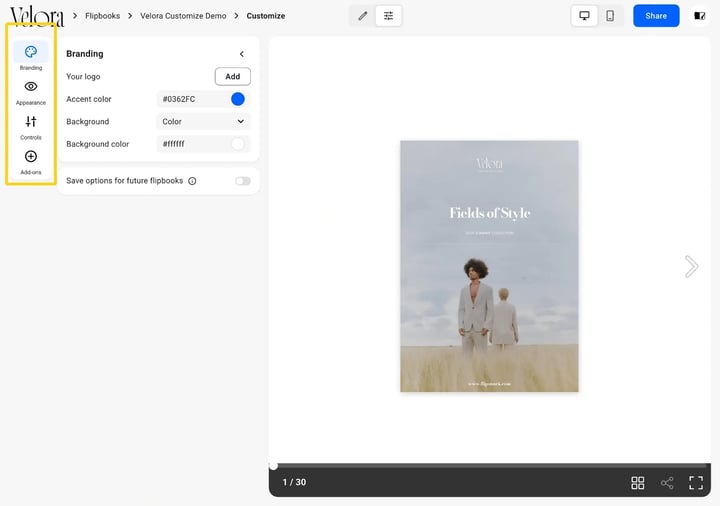
- Branding holds your logo, the accent color the player uses for its own controls, and what sits behind the flipbook.
- Appearance holds how pages turn, the skin, the layout, and details like page shadows and link highlights.
- Controls holds every control the reader is given, from fullscreen down to downloading and printing.
- Add-ons holds eight features that each open a screen of their own. Its header reads Add options.
Branding
Four settings, and they are the flipbook's visual identity.
- Your logo. Click Add to upload one. It appears in the player and can carry a link to your site.
- Accent color. The color the player paints its own interface with: the progress bar, selected items and hover states. It starts at #0362FC, the Flipsnack blue.
- Background. A dropdown with Color, Image and Transparent. It starts on Color.
- Background color. The hex value behind the flipbook when Background is set to Color.
Step by step, with what each color affects: How to change your flipbook's branding and logo.
Appearance
Page transition is the first setting and the one readers notice: Flip, Slide or Scroll. Below it sit the mobile transition, auto transition, flip sound, the Skin and Layout style dropdowns, and the switches for page shadows, right to left orientation, animated interactions, link highlights, text selection and tooltip language.
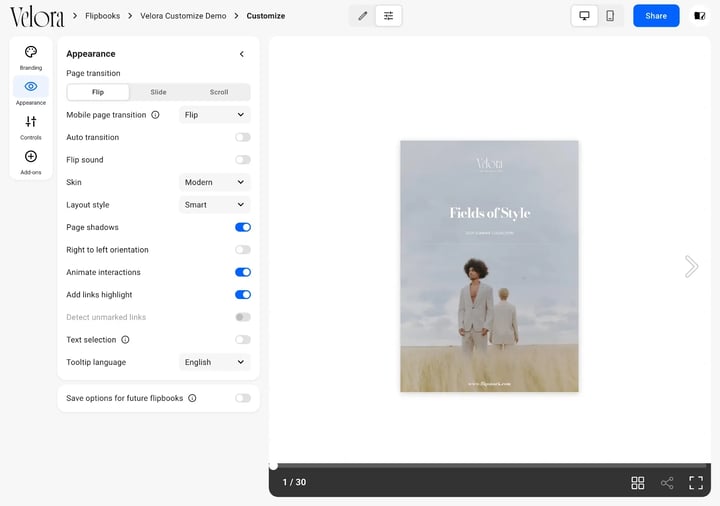
Every one of them, with its default: How to change your flipbook's appearance settings.
Controls
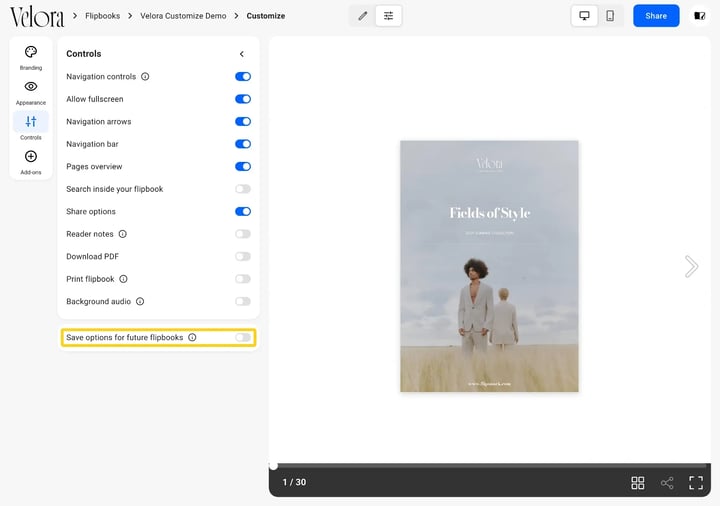
Eleven switches, one per thing a reader can do. Navigation controls is the parent: turn it off and fullscreen, the arrows, the navigation bar, the pages overview, search and sharing go with it. Download PDF, Print flipbook, Reader notes, Background audio and Search inside your flipbook start off.
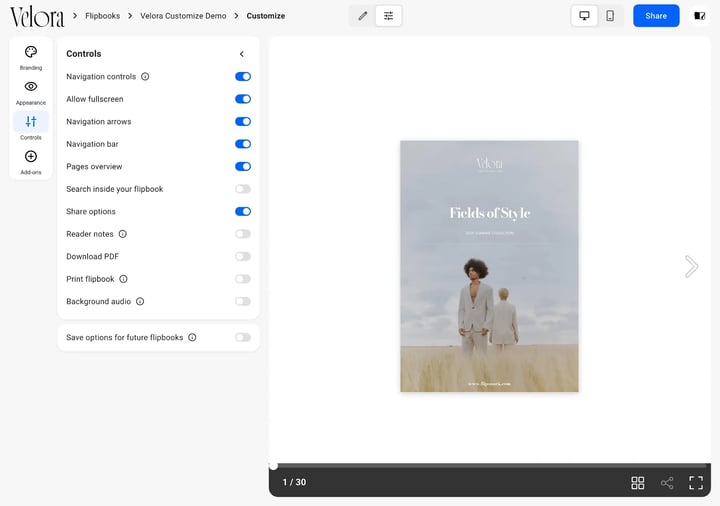
What each switch changes for the reader: How to change the controls your readers get.
Add-ons
Eight rows, no switches. Each opens its own screen, and each has a toggle there that has to go on before its settings exist.
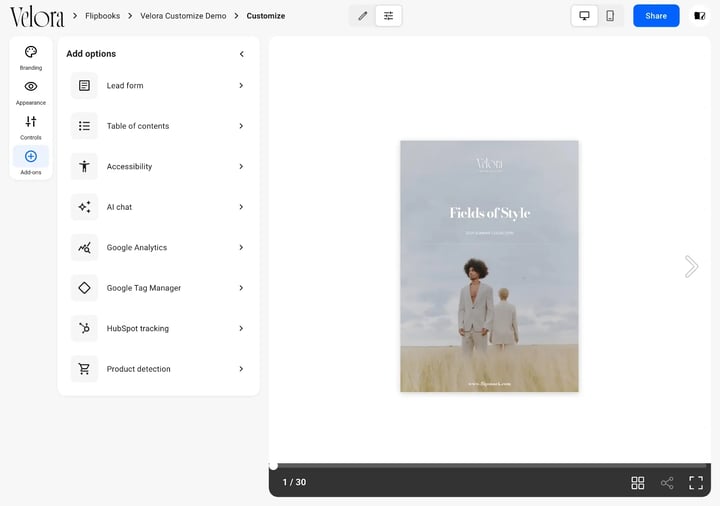
- Lead form puts a form between two pages and collects reader contact details.
- Table of contents gives readers a chapter list they can jump from.
- Accessibility adds the page descriptions a screen reader reads out.
- AI chat opens its own screen for a reader-facing chat about the flipbook's content.
- Google Analytics sends flipbook traffic to your GA4 property.
- Google Tag Manager loads your container inside the player.
- HubSpot tracking records reader activity against your HubSpot contacts.
- Product detection finds products on the pages of an uploaded catalog.
To leave a screen and go back to the list, use the back arrow at the top of the panel.
Save options for future flipbooks
A card under Branding, Appearance and Controls, repeated on all three and absent from Add-ons. Switch it on and the settings on that panel become the starting point for the flipbooks you make next. It changes nothing about the flipbook in front of you.
Reaching your readers: Share, then Update
Readers are served the published copy of the flipbook, so a setting changed here is not a setting they see. Click Share in the top right, then Update in the Publish your flipbook modal. On a flipbook you have never published, that button reads Publish instead.
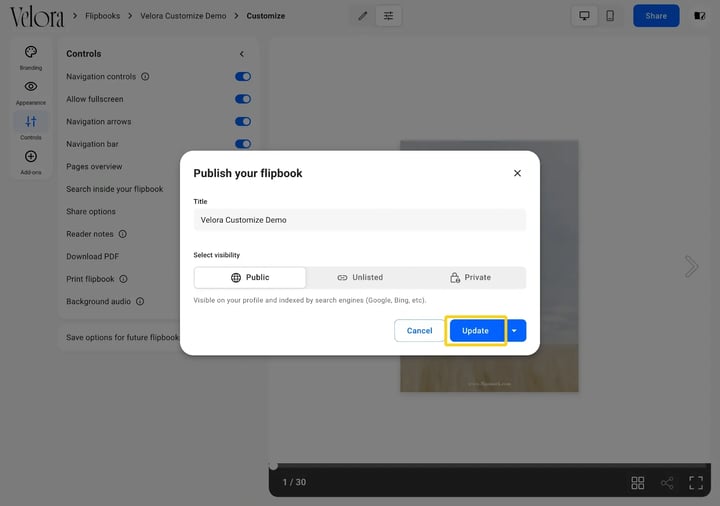
The same modal sets visibility. Public is listed on your profile and indexed by search engines, Unlisted works for anyone with the link, Private asks for a password or an email.
Additional tips / FAQs
- I turned a setting off and readers still see it. The published copy has not caught up. Click Share, then Update.
- Where did Table of contents go? It is a row in Add-ons now, not a switch on a panel.
- Is there an Update button on the page? No. The top bar carries the preview toggles and Share, and Update lives one click further on.
- Does Customize change the pages themselves? No. Text, images and links are the Design Studio's job.
Next steps
- How to change your flipbook's appearance settings
- How to change the controls your readers get
- How to change your flipbook's branding and logo
- Flipbook player skins: the options and how to choose one
Need expert support?
Our team is here to help. Connect with our team experts or message us via the live chat for personalized assistance.