
💡 Benefits of giving your flipbook a QR code
- A scan opens the flipbook: so a printed address never has to be typed, and nobody is lost to a typo.
- The code points at the live flipbook: update prices or pages and the poster on the wall is still right.
- Your logo in the middle of the code: so it reads as yours rather than as a generic square.
- SVG for a press, JPG and PNG for everything else: all three download from the same tab.
- Scans arrive as ordinary flipbook views: so they show up in your Flipsnack statistics with everything else.
Overview
Flipsnack generates a QR code for any published flipbook from the Share menu, on every plan including Free. Scanning it opens the flipbook in the reader's mobile browser, with no app and no typed address. You can add your logo to the middle of the code and download it as a JPG, PNG or SVG, ready for a poster, a menu, a business card or a product label.
👥 Where a flipbook QR code is helpful
- Retail displays: print the code on in-store posters and shelf talkers so shoppers open the catalog on their own phone.
- Trade shows: put it on booth panels and business cards so visitors can browse the catalog after the event, like Melissa & Doug.
- Restaurants and hotels: a code on the table or in a room holder opens the menu, the daily specials or the guest directory.
- Offices: a code on a noticeboard gives staff the current training manual instead of a printed copy nobody updates.
- Packaging and manuals: a code on the box opens the latest instructions, which you can revise without touching the print run.
Requirements
- A published flipbook: publish one
How to create a QR code for your flipbook
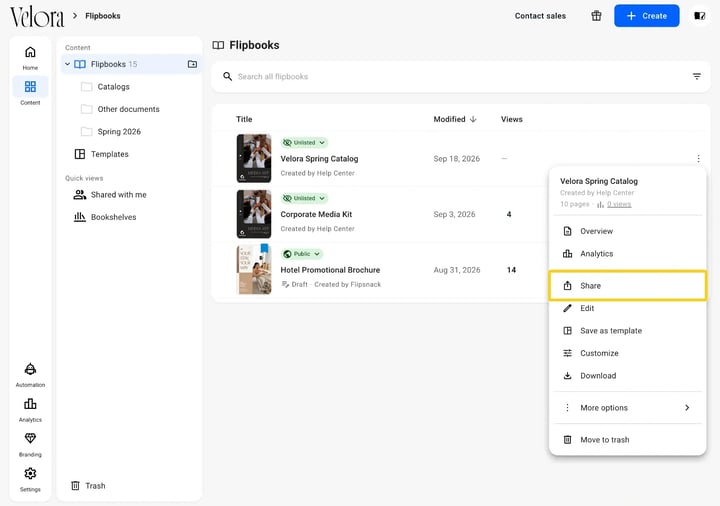
- Open Content → Flipbooks, hover the published flipbook you want a code for, and click the ⋮ menu at the end of its row. Choose Share.
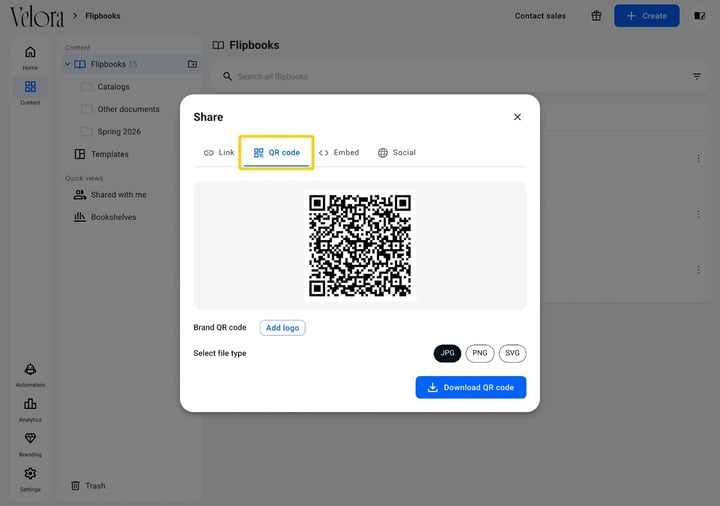
- In the Share window, open the QR code tab. The code is generated straight away and already points at your published flipbook.
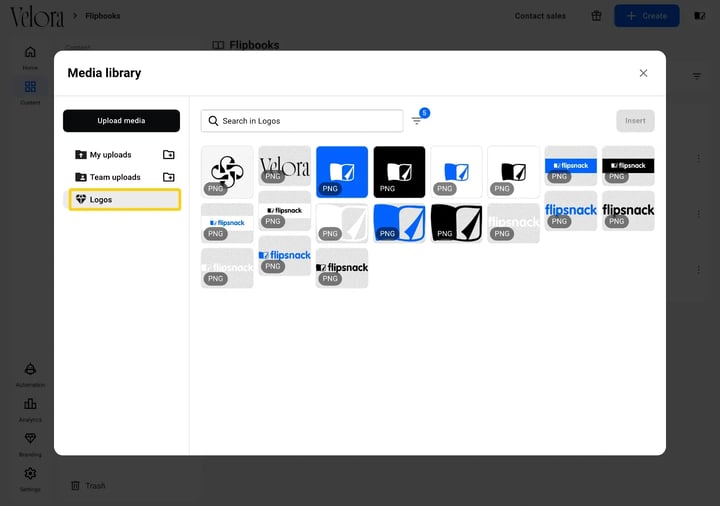
- To brand it, click Add logo next to Brand QR code and pick an image from your Media library. Logos holds the ones already uploaded for your workspace; Upload media adds a new one.
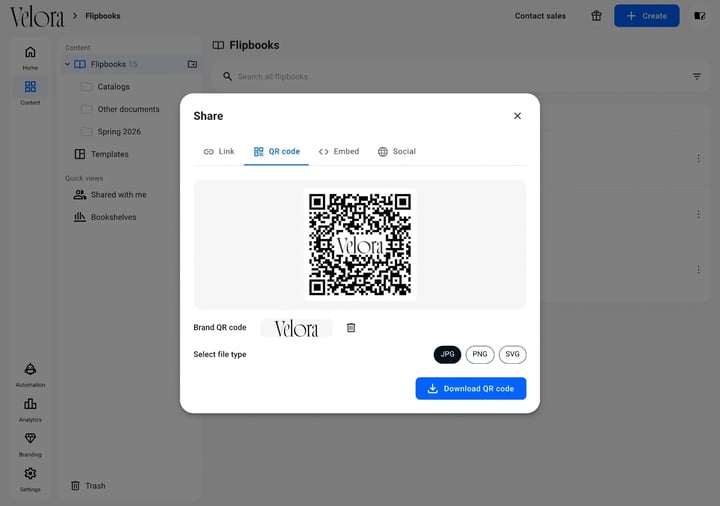
- Your logo appears in the middle of the code. Use the bin icon beside the thumbnail to remove it again.
- Under Select file type, choose JPG, PNG or SVG, then click Download QR code. Pick SVG when the code is going to print, since it stays sharp at any size.
How long does a flipbook QR code stay active?
The code points at your published flipbook rather than at a fixed image, so it keeps working for as long as that flipbook stays published in your account. Edit the flipbook and the same printed code opens the new version, so you never reprint because the content changed.
It stops working if you unpublish or delete the flipbook, or if a premium subscription lapses and the flipbook comes offline with it. If a scan fails, check the flipbook is still published before anything else.
Tip: If you need a copy that works without an active Flipsnack account, download your flipbook in HTML5 format (Business plan) and host it yourself. Export it before unpublishing, while the flipbook is still available.
Additional tips / FAQs
- Can I generate a QR code for a draft? No. The flipbook has to be published first, because the code encodes its public link.
- Does the code change when I edit the flipbook? No. It points at the flipbook's link, so edits appear behind the same code and printed material stays valid.
- Which file type should I print? SVG. It is a vector, so it scales from a business card to a shop window without going soft. JPG and PNG are fine on screen and in small print.
- Why will my branded code not scan? A logo that covers too much of the code leaves too little for a scanner to read. Use a small, high-contrast logo, then test the code with a phone before sending it to print.
- Can I see how many people scanned it? Not as scans . A scan opens the flipbook, so it counts as a view in your flipbook statistics along with every other visit.
Next steps
- Public sharing options explained: links, QR codes, and more
- How and where can you share a flipbook as a direct link?
- How to edit the link name of a published flipbook's URL
- How to download your flipbook in HTML5 format
Need expert support?
Our team is here to help. Connect with our team experts or message us via the live chat for personalized assistance.