
Overview
Search engines and AI assistants have always had a blind spot with flipbooks. They could read the title, the description and a few elements around the viewer, but the content inside stayed invisible, because a flipbook renders in a viewer rather than as crawlable HTML.
Optimize SEO changes that. Flipsnack uses AI to extract your flipbook's text and write it into the page as plain HTML, just below the viewer. That's what search engines and AI tools read: ChatGPT, Gemini, Perplexity, Copilot, Google AI Overviews.
Readers never see that text. They still land on the same interactive flipbook, page turns and all. So your catalog becomes findable in search results and AI answers without being flattened into a static page.
This means your existing content can now contribute to:
- appearing in search results
- being selected for AI-generated answers
- being cited as a source in AI responses
The feature works for both existing and future Public flipbooks, so you don't need to republish your catalogs. Once you have extracted the text, your published content becomes crawlable and eligible for indexing.
SEO decides whether your catalog ranks. AEO and GEO decide whether it gets quoted. Ahrefs measured a 58% drop in click through rate for top ranking content once AI Overviews appear, and Gartner expects search volume to fall by around a quarter.
Flipbooks have an extra problem: your text sits inside the player, so engines see your metadata and little else.
Requirements
- Any paid plan. Custom domain needs Business or Enterprise.
- A flipbook published as Public: set the visibility
AEO vs GEO
AEO is extraction. You want to be the passage lifted and shown as the answer.
GEO is citation. You want to be a source a model draws on when it composes an answer from several places.
AEO wins you the answer. GEO wins you the citation inside someone else's answer.
Note: The vocabulary is not settled. There is no consensus definition separating AEO, GEO, LLMO, and AIO, and practitioners use them interchangeably. Treat it as a lens for deciding what to produce, not two programmes to budget. The overlap is large.
AEO and GEO side by side
Why flipbooks need crawlable text
A flipbook is a player, not a text document. A catalog with 200 pages of specifications and a few hundred characters of metadata is, to an answer engine, a few hundred characters long.
Extracting the text fixes this. Flipsnack writes your catalog's contents into the page as ordinary HTML, headings, sections and a table of contents, so that an engine reads real text instead of interpreting a canvas. Three things follow:
- Real text beats text in images. Serialization only captures text that exists as text. Flattened artwork and image only PDFs serialize to nothing.
- It is article shaped, not product shaped. Good for topical and comparative questions. Weak for price, stock, and variant questions, which is what a host page covers.
- Your spread copy becomes source material. Question style headings and direct opening sentences now work as AEO levers inside the catalog.
To verify: view the page source on your published catalog and look for the structured data block. Missing means the feature is not active yet. Present but empty means the catalog is image based, which is a design fix rather than a support ticket.
Settings that gate visibility
Three settings sit upstream of everything else, and each can silently undo the rest.
- Visibility. Only Public is indexed. Unlisted, private, and password protected carry noindex.
- The profile toggle. A separate Profile options setting on Overview controls whether each flipbook appears on your public profile. Audit it. That profile is a free entity hub listing every catalog under one brand string.
- Share link choice. Full-view strips the menu, footer, and related publications. The standard link keeps them, giving crawlers more text and internal links. Use full-view for embeds, the fuller page for anything you want cited.
Warning: Publishing is one way. A catalog can be changed from unlisted to public, but not back to unlisted. Decide visibility before you publish anything you may later need to restrict.
What to do for AEO
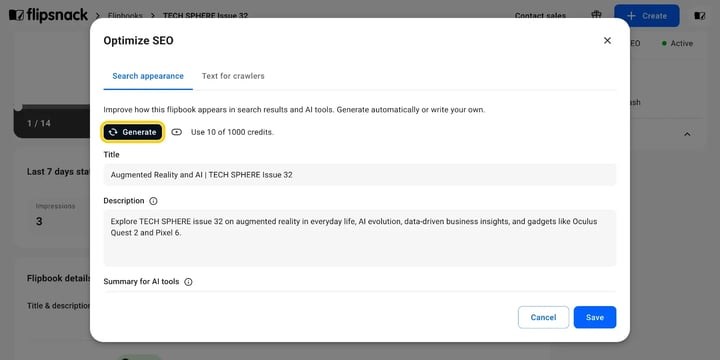
- Write metadata as an answer, not a label. "Spring Collection 2026" is a label. "Spring 2026 collection: 240 SKUs, wholesale pricing, ships from Rotterdam" answers something. Set it with Optimize SEO on the Overview page. Keep meta titles under 60 characters, since Flipsnack appends your author name.
- Turn product images into stated facts. Clickable SKUs give name, price, availability, and variant as text. These are exactly the short factual questions AEO serves.
- Lead with the answer on the page itself. Question style headings, direct first sentences, specifications as text rather than graphics.
You do not have to write these fields by hand. Flipsnack can now generate the meta title, the meta description, and the abstract (labelled Summary for AI tools) with AI, based on the content of your publication, straight from the Search appearance tab of the same Optimize SEO panel. Each generation uses 10 AI credits, and you can edit or regenerate the result before saving. See the full steps in our SEO optimization article.
What to do for GEO
- Build a host page around the embed. A normal HTML page carrying the answerable content in crawlable text beside the flipbook: specs, pricing logic, lead times, FAQ. The flipbook is the experience, the host page is what engines quote and you can mark up.
- Add statistics and named sources. The Princeton GEO study found expert quotes lifted visibility by roughly 41%, statistics by about 30%, and citations by around 30%.
- Mark up the host page. FAQ and Product schema cover the product level questions the serialized article form does not.
- Keep catalogs current. Freshness is a live retrieval input, so a stale catalog is a citation handed to a competitor. The Catalog Generator handles this at scale.
- Earn links and embeds. Both a ranking factor and a retrieval signal.
Platforms differ. AI Overviews draw mostly from the top ten, so ranking still gates entry. Perplexity leans on freshness and authority. Copilot pulls heavily on LinkedIn for B2B.
Why your domain matters now
In classic SEO, a custom domain is a branding decision. In a zero click world it is an attribution decision. When an engine cites a source, it surfaces the domain. On a Flipsnack URL the citation credits Flipsnack. On catalogs.yourbrand.com it credits you, in the one place the reader is looking.
It also consolidates your entity. Generative systems assemble a brand from scattered mentions, and keeping every catalog on one domain feeds one entity instead of splitting authority.
Tip: Custom domains come with Business and Enterprise and cover every catalog in your account, so it is a one time setup. A keyword bearing subdomain adds a little more: catalogs.yourbrand.com improves your odds on "yourbrand catalogs". Swap in whatever noun your buyers search, such as issues, reports, or price lists. See using a custom domain, or ask support via the in-app chat.
It is not a ranking cheat, and it will not rescue a catalog with no readable text. Content indexing comes first. The domain decides who gets credit once you are cited.
What to measure
Rank tracking will not tell you if this worked, because the outcome happens inside a generated answer with no position to track.
- Prompt panels. A fixed set of buyer questions run across ChatGPT, Perplexity, Copilot, and Gemini on a schedule. Log mentioned, cited, or absent.
- Share of voice. Who else shows up on that same prompt set. Usually more actionable than your own numbers.
- AI referral traffic. Low volume, high intent. Segment it, and use trackable links where you control the cited URL.
- Flipbook analytics. Views, reading time, and downloads show what happened after the click.
Caution: Nobody can guarantee placement in AI answers. There is no submission endpoint and no ranking dial. Any vendor promising guaranteed AI visibility is selling something that does not exist.
Additional tips / FAQs
- Should AEO and GEO be separate workstreams? No. Build one programme around making content easy to quote accurately. If you must sequence, AEO basics first.
- Does classic SEO still matter? Yes. AI Overviews mostly pull from the top ten, so ranking is the entry ticket.
- We turned it on and nothing changed. Why? Open your published flipbook and view the page source: the extracted text should appear as an article block below the flipbook player. If it is missing, the extraction has not run yet, open Optimize SEO and generate. If it is there but nearly empty, the catalog is flattened images with no text to extract.
- Will an unlisted catalog appear in AI answers? No. Unlisted and private carry noindex.
- Is a custom domain worth it for AI visibility alone? Not on its own. Paired with indexed contents, yes, because it decides whose domain appears in the citation.
Next steps
- Optimizing your flipbook catalogs for search engines and AI answers
- Using a custom domain with Flipsnack
- Catalog Generator
- Tracking your publication's statistics
Need expert support?
Our team is here to help. Connect with our team experts or message us via the live chat for personalized assistance.